
Forgiveness: A State of Being, Not Something You Do
What is forgiveness, really? And why did Jesus place such emphasis on it?
In Matthew 18:21-22 (NKJV), Peter comes to Jesus with what he thinks is a generous question: “Then Peter came to Him and said, ‘Lord, how often shall my brother sin against me, and I forgive him? Up to seven times?’ Jesus said to him, ‘I do not say to you, up to seven times, but up to seventy times seven.’”
Peter probably felt pretty magnanimous suggesting seven times—after all, the rabbis often taught three times was enough. But Jesus doubles it (and then some) to seventy times seven = 490 times. That number isn’t meant to be a literal scorecard. It’s an impossibility in human terms. Jesus is showing Peter (and us) that forgiveness isn’t about keeping count. It’s not primarily about the other person at all.
Yes, forgiving someone can restore a relationship, bring peace between people, and open the door for healing. But the deeper truth is this: forgiveness changes your heart and your life far more than it changes theirs.
To me, forgiveness isn’t a single action or a “deed” I check off a list. It’s a state of mind and the condition of my heart. It’s the place I choose to live from every day.
When I truly see that what people do, how they act, what they say, how they treat me, is about them and not about me, forgiveness becomes so much easier. Their words, their silence, their rudeness, their choices, it all stems from their own hurts, fears, insecurities, or struggles. I’m not the center of their story. And once I stop making it about me, the offense loses its grip.
In our world today, offenses are everywhere. It’s so easy to take it. We take offense when we assume we know why someone did something. We assign motives: “They said that because they don’t respect me.” “They ignored me because they hate me.” “They hurt me on purpose.” But the truth is, we are not the Holy Spirit. We cannot read hearts or see thoughts. We don’t know the full story behind anyone’s actions.
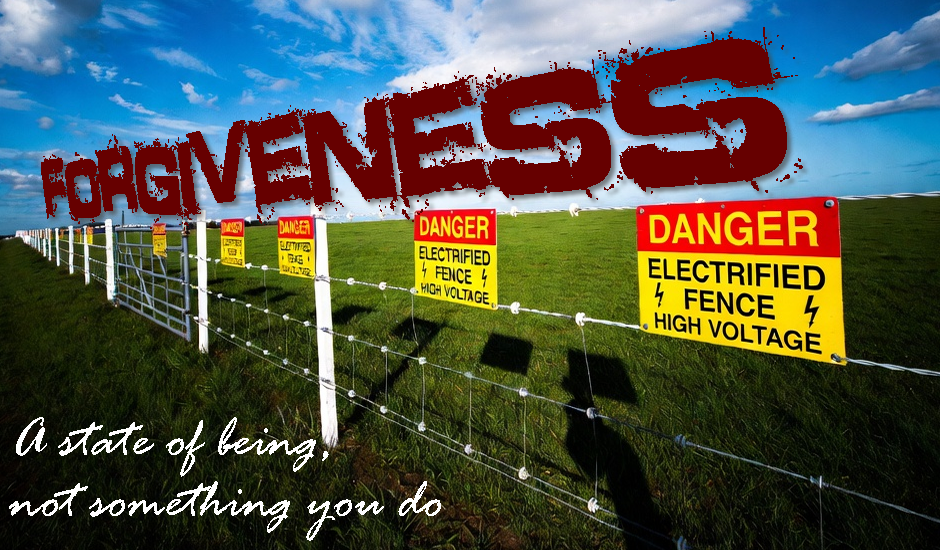
Here’s the key: offense only has power if we take it. It doesn’t automatically land on us, it has to be picked up and carried. If we decide not to take it, it has no authority over us. The real power of offense is that it builds a wall, maybe even a literal fence, around our heart. The thing about the fence is not only that it keeps things out - it also keeps things in. It not only keeps the bad out but nothing good can get in or out until we choose to tear that fence down.
Let me give you a simple, everyday example: I walk into church this morning, and the Pastor passes right by me. I smile and say “Hi,” but he completely ignores me, no eye contact, no acknowledgment.
Now I have two choices:
1. “Wow, that’s rude! I didn’t even do anything wrong. He never really liked me anyway. All those other times he was friendly? Fake. He must hate me.” → Offense taken. Wall built. Heart hardened. Bitterness starts to grow.
2. “Wow, Lord, You saw that. I wonder what’s going on in this moment for him. You know his heart and mind. It must be something important he is having to deal with. → Offense released. Heart stays open. Love flows instead of resentment.
The first response comes from a selfish heart that believes everything revolves around me. The second comes from a heart established in God’s love, a heart that seeks the good of others above my own feelings.
When I live from a place filled with the abundance of God’s love, forgiveness stops being something I “have to do.” It flows naturally. I don’t have to grit my teeth and force it. I don’t keep score. I don’t rehearse the hurt. My heart is already free because it’s full of Him.
Forgiveness is choosing to live free from offense, free from bitterness, free to love even when it’s not returned. And in that freedom, we reflect the heart of our Father, who forgave us completely through Jesus.
Let’s pray this together:
“Father, thank You that You forgave me completely. Help me to live from a heart full of Your love, not a heart that takes offense. When someone hurts me or ignores me, remind me it’s not about me, but rather it’s about them. Show me how to release every fence, every wall, and let Your love flow through me instead. Teach me to forgive, not seven times, not 490 times, but as a way of life. In Jesus’ name, Amen.”
What’s one situation where choosing not to take offense has made a difference in your life? Or where you’re asking God for help to release an offence right now?
Live from the place of forgiveness. It’s not just for them, it’s freedom for you.