
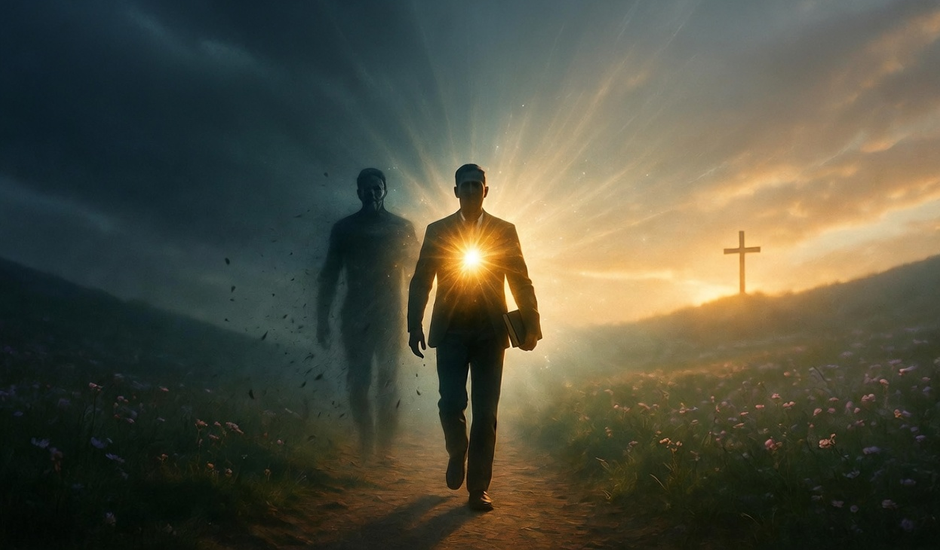
Dead Man Walking: The Body Is Dead to Sin—Now Live by the Spirit
I love a good, clean murder mystery. I’ll read one and try to figure out the “who dunnit” long before the reveal. So when I read Romans 8 about a year ago, it tickled my detective bone. I wanted to solve the who, what, and why of these verses.
Let’s look at Romans 8:9–11 (NKJV):
“But you are not in the flesh but in the Spirit, if indeed the Spirit of God dwells in you. Now if anyone does not have the Spirit of Christ, he is not His. And if Christ is in you, the body is dead because of sin, but the Spirit is life because of righteousness. But if the Spirit of Him who raised Jesus from the dead dwells in you, He who raised Christ from the dead will also give life to your mortal bodies through His Spirit who dwells in you.”
The Who
Verse 9 starts with a keyword: “you.” Paul is writing to born-again believers in Rome—not unbelievers, not people still living according to the world. These are Christians. He reminds them of who they are and whose they are.
Even though they were still living in the same circumstances as before, something fundamental had changed. In themselves, they were different.
Galatians 2:20 says: “I have been crucified with Christ; it is no longer I who live, but Christ lives in me; and the life which I now live in the flesh I live by faith in the Son of God, who loved me and gave Himself for me.”
The old me has been crucified with Christ. Positionally, it already happened. The old man is gone. I might be oblivious, ignorant, or stubborn and keep acting like he’s still alive—but the truth is, he’s dead.
The next keyword is “flesh.” In the New Testament, this refers to the sinful element of human nature. To be “in the flesh” means living unrenewed, according to carnal desires and sinful impulses.
Galatians 5:24 declares: “And those who are Christ’s have crucified the flesh with its passions and desires.”
Paul calls us not only to lay down the old man and its deeds, but to accept that it has been crucified with Christ. There is no old man/flesh to go back to—just a sack of dry, useless bones.
The What
If Christ is in us, the body is dead because of sin. This isn’t punishment, it’s a consequence. Sin brought death, but Jesus dealt with sin once for all.
Verse 10: “And if Christ is in you, the body is dead because of sin, but the Spirit is life because of righteousness.”
The Greek word for “dead” here means a corpse—one that has breathed its last, without life, inanimate, destitute of power. The body is dead in respect to sin—sin has no more power to bring forth evil thoughts, desires, or control.
Think about a corpse:
• It smells.
• It attracts bugs.
• It’s stiff—no movement, no walking, no dancing.
A dead body cannot contract disease or develop cancer. A corpse doesn’t fear, doesn’t have anxiety, doesn’t battle depression.
Romans 6:11 commands: “Likewise you also, reckon yourselves to be dead indeed to sin, but alive to God in Christ Jesus our Lord.”
Sickness and disease entered through sin. If the body is dead to sin, it is dead to sickness and disease as well.
When symptoms try to shout louder than the truth, I remind myself: my body is dead to sin and therefore dead to its consequences (Romans 6:11). The work is already finished on the cross. Jesus bore my sicknesses and carried my pains (Isaiah 53:4-5; Matthew 8:17). I can take authority because it’s done.
But sometimes a headache hits, and honestly? I just pop a pill instead of standing on the truth. The principle didn’t change—my effort did.
Let me be clear: there is nothing wrong with taking a headache tablet when needed. God is not keeping score. This is not about performance or condemnation. It’s about training.
Just like physical muscles grow stronger through consistent, repeated exercise, our faith muscles strengthen through practice.
When I consistently choose to put the Word into practice on the smaller, everyday things—like a headache, a minor ache, or a wave of anxiety—something shifts inside me. My spirit becomes more familiar with living from the finished work. My soul (mind, will, and emotions) gets retrained to agree with my new, perfect spirit instead of defaulting to the flesh.
The more I exercise this on the “little foxes” (Song of Solomon 2:15), the easier it becomes to stand firm when bigger challenges come. Putting the Word into practice starts small and builds confidence. Each time I choose truth over the easy way out, my spiritual muscles grow. Before long, standing on healing isn’t a huge battle—it becomes my normal response because I’ve strengthened that muscle day by day.
This is the beauty of the New Covenant. We don’t have to manufacture faith in our own strength. We simply renew our minds with what is already true in our spirit (Romans 12:2) and practice walking in it. Little by little, we live more fully as the new creation we already are.
The Why
Verse 11: “But if the Spirit of Him who raised Jesus from the dead dwells in you, He who raised Christ from the dead will also give life to your mortal bodies through His Spirit who dwells in you.”
The same Spirit that raised Jesus from the dead lives in us. “Dwell” means to occupy a house, to reside, to cohabit—intimacy of connection. The Spirit influences, directs, and guides the one He dwells in.
John 14:17: “…the Spirit of truth, whom the world cannot receive, because it neither sees Him nor knows Him; but you know Him, for He dwells with you and will be in you.”
The indwelling Spirit is the mark of every believer. It distinguishes us from the world.
“Quicken” means to make alive, to restore to life, to endue with new and greater powers of life. By yielding to the Spirit, the entire person—body, soul, and spirit—is made alive to God. Even the mortal body, once under sin’s dominion, is quickened.
Ephesians 2:4–6: “But God, who is rich in mercy, because of His great love with which He loved us, even when we were dead in trespasses, made us alive together with Christ (by grace you have been saved), and raised us up together, and made us sit together in the heavenly places in Christ Jesus.”
Our identity is not in ourselves—it is established in Christ. We are dead to sin, sickness, fear, anxiety, and alive with the life of God.
Conclusion – Be a Dead Man Walking
Who: Born-again believers.
What: The body is dead to sin (and its consequences).
Why: So that the Spirit who raised Jesus can dwell in us, quicken our mortal bodies, and make us fully alive to God.
When I truly believe my body is dead to sin, disease, fear, anxiety—when I believe I am indwelt by the Holy Spirit—I will live differently. I will walk according to the Spirit of life within me, taking full advantage of every day for His purpose.
My challenge to you: Be a dead man walking. Walk dead to sin and alive to God. Let the Spirit quicken every part of you. Live in the fullness of life Jesus promised—overflowing, abundant, free.
Pray with me: “Father, thank You that I am crucified with Christ. The old me is dead. Thank You that my body is dead to sin and its consequences—sickness, fear, anxiety, lack. Thank You for the Spirit who raised Jesus living in me, quickening my mortal body. Help me live as a dead man walking—dead to the old, fully alive in You. In Jesus’ name, Amen.”
You’re not just surviving. You’re a dead man walking—alive in Christ, carrying resurrection life wherever you go. Walk in it today!